
Field Note: 'Someone Should Know Our Story'
Partha Sarathi Biswas

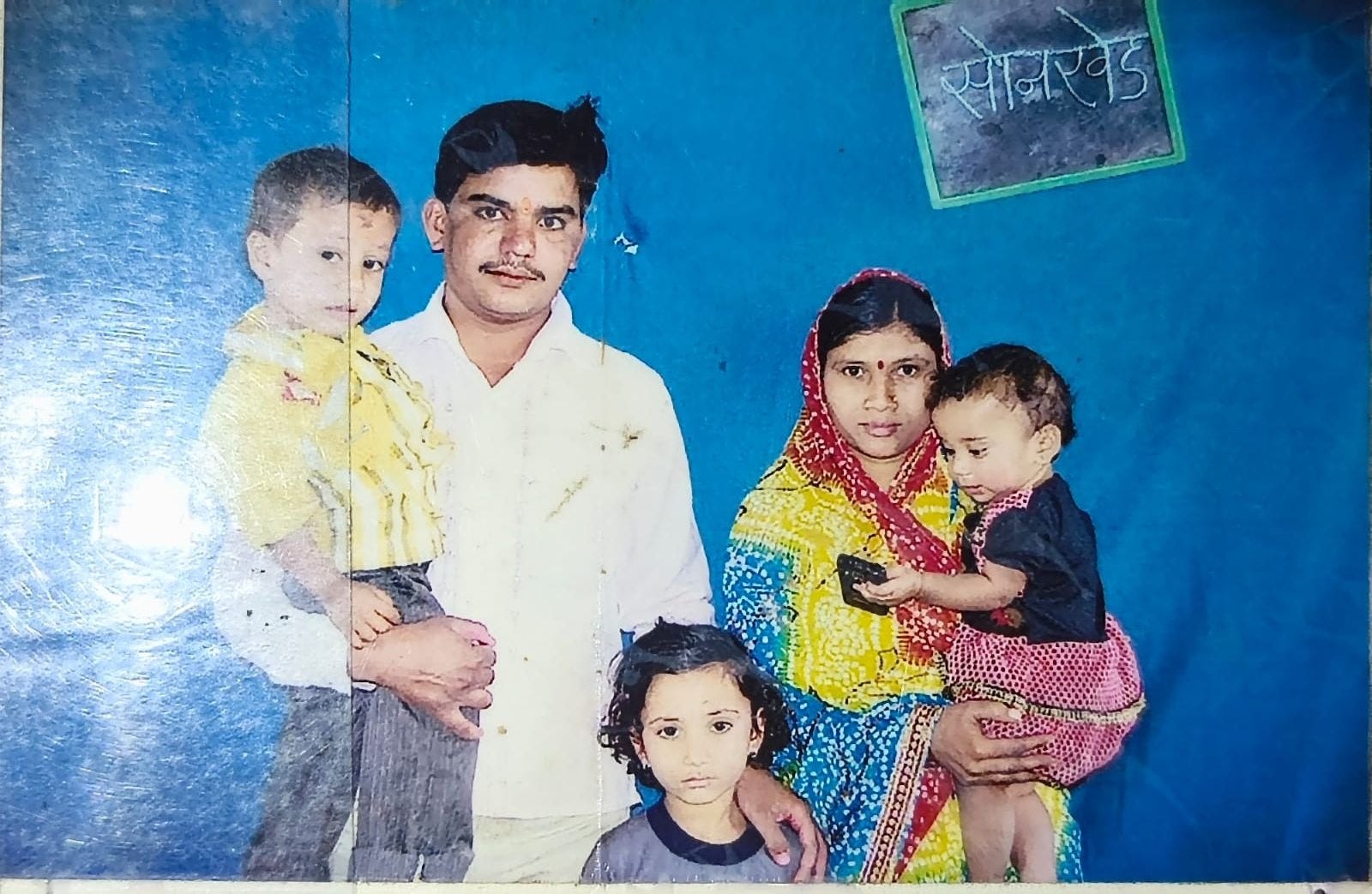
When I met Vinayak More, I really did not know how to ask the 17-year-old about his father’s death.
A soft spoken teenager, Vinayak, was in a hurry to report to work—at a small event management company in rural Maharashtra that caters to birthdays, weddings, and other functions. His gelled hair and stone-washed jeans were in tune with the day’s style. It took a while for the grimmer reality underneath to surface.
He was six when his father, Shivaji, died by suicide in 2016, outside the town of Nanded. He has only faint recollections of the man who once held him for the photograph above. Shivaji had been a farmer—soybeans and cotton—before the land stopped being enough to get by, and he took to labouring on other people’s farms instead. After he died, it wasn’t long before Vinayak’s mother became a labourer too.
Vinayak studied up to 10th standard before dropping out to help his mother. His ambitions are modest, and still out of reach. “I wish I had the money to enrol in an ITI course to learn electrical fitting,” he said wistfully. “But it looks difficult.”
As a journalist, I’ve seen my share of tragedy. But it is always unsettling to come face to face with the people behind the data—in this case, National Crime Records Bureau figures showing that, for the first time since separate records began in 2014, agricultural labourers are now dying by suicide in greater numbers than farmers who own or farm land. I’ve always believed that when data acquire a name and a face, reporting takes a break, and journalism begins.
Long before any of us got into this profession, the veteran farm leader Sharad Joshi spoke of two countries within one—Bharat and India. Bharat stayed in the villages, he argued, while urban India grew at its expense. I thought of Joshi that day, listening to Vinayak talk about the dreams he’d had to put away for lack of money.
Farm suicides have been reported across the country for years, but every story is still a learning experience for me—even in Maharashtra, my home state, where I have travelled to nearly every district. Reporting this one, I met people who had fought long odds and were still fighting them, in their own way.
Manish Jadhav, a farm leader in Yavatmal, was one of them. He had travelled the length and breadth of his district and seemed to know everything about it—its farms, its land, its people. He spoke at length about migration, poverty, and the absence of opportunity. Sitting with him, I understood how much knowledge people generate simply by living in a place the State has stopped paying attention to.
In the cotton belt of Yavatmal, knowledge is not in short supply. What’s missing is anyone willing to listen to it. People’s own understanding of their land deserves more respect than it gets—their lived experience speaks to a place in ways no planner, journalist, scientist, bureaucrat, or politician ever quite manages. We only have to listen.
Everywhere I went, people were willing to talk. What struck me most was how even the most distressed among them went out of their way to welcome a guest. Even when time was precious, they made time. In Washim, some villagers gave up a day’s work just to sit and talk with me. Their reason was simple. As one of them put it: someone should know our story.
Read Partha Sarathi Biswas’ full story here.
Also Read:
Field Note: ‘I Am Their Owner’

At the outset, it may seem that work at shrimp farms is not “labour-intensive”—something the supervisors and farm owners in Surat, Gujarat, repeatedly told me, a labour researcher, and members of the Majur Adhikar Manch,