
Field Note: ‘I Am Their Owner’
Anamika Singh

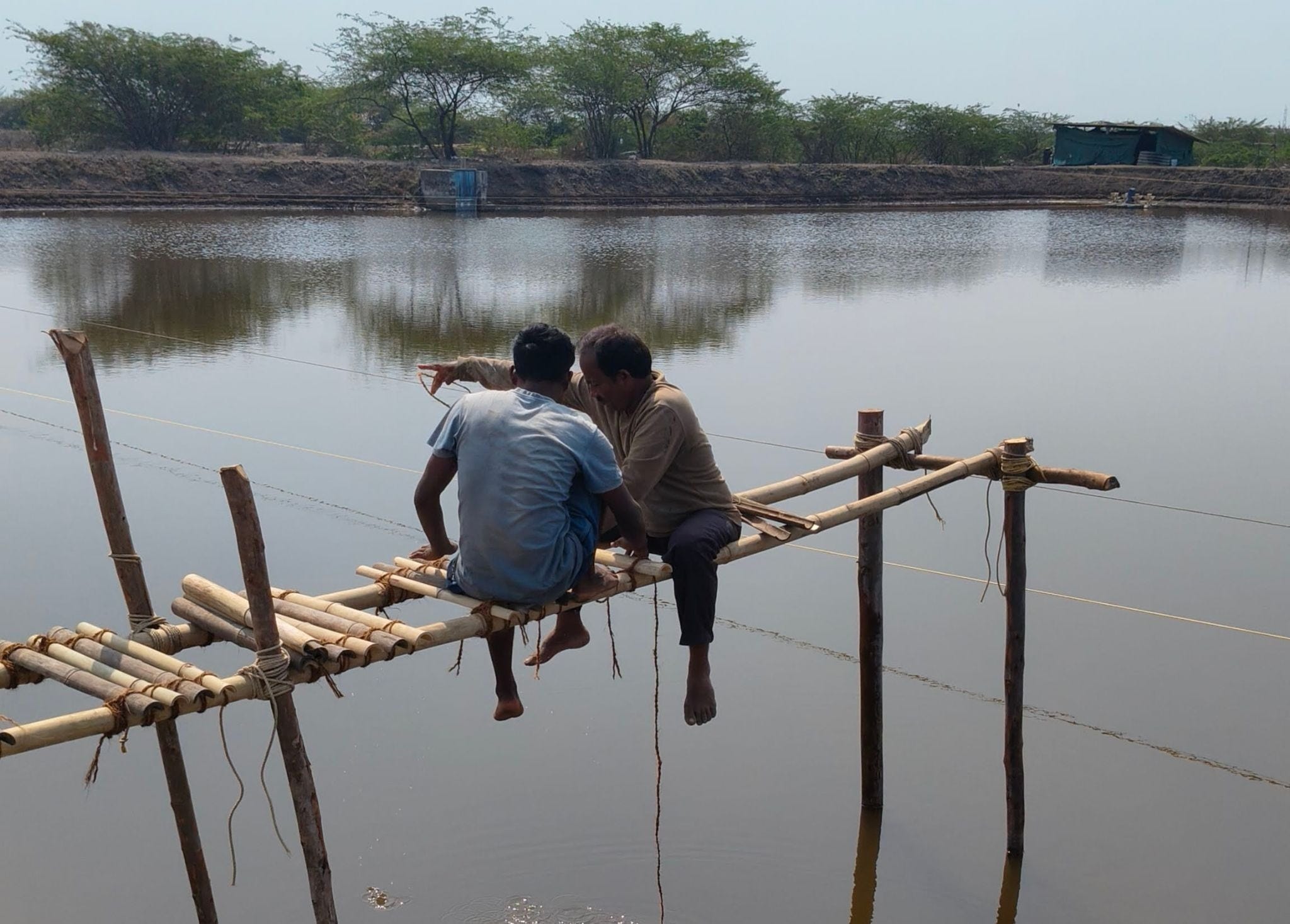
At the outset, it may seem that work at shrimp farms is not “labour-intensive”—something the supervisors and farm owners in Surat, Gujarat, repeatedly told me, a labour researcher, and members of the Majur Adhikar Manch, a Gujarat-based trade union, during our monthly visits to farms in Olpad and Choryasi tehsil.
They often pointed to the workers resting, describing how there are only three or four times during the day when they are supposed to be performing some activity.
Otherwise, we were told, workers are on the charpai, “leisurely hanging out”.
It was difficult to accept this narrative when supervisors and owners often refused to let us speak to the workers directly.
The workers seemed to have been denied the agency to decide whom they wish to speak to and whom they wish to stay silent in front of.
During our initial visits, we were left sitting and nodding along to the larger “economics of the trade”, which the supervisors attempted to divert our attention to when we brought up the conditions under which the workers are labouring at the farm.
“The government provides no support or subsidies to the farm owners,” was a sentence often repeated.
Perhaps this was the rationale used to deny labour rights.
In the midst of this, the workers, who had not uttered a single word during the entire conversation, stood in silence.
It took us 3-4 visits to finally break this silence by finding ways to speak to workers when the supervisors or owners were not around.
Working with a trade union, the agenda of any action research is to finally move towards organising, the most critical labour right. But how do migrant workers even begin to speak about collective action when they work on isolated farms with their movements constantly watched and controlled?
The perception of ‘idleness’ has permeated among the workers as well. Not because the work isn’t tedious. There are many laborious and technical tasks that, if not done properly, result in a poor crop and losses for farm owners, companies, and other actors down the supply chain.
The reason is the comparison with life at dingy factories where they worked earlier. The farms become a lesser evil in that sense, even though workers’ choices remain heavily constrained, as we found out.
“Yeh mere mazdur hein” (These are my workers),
“Mainey inhe paise diye hein” (I have given them money),
“Mein inka seth hun” (I am their owner),
“Mein inko yahan laya hun” (I got them here).
These were some of the phrases directed at us, if owners found us speaking to workers without their permission. In a way, everything on that land becomes theirs, including the shrimps in the ponds and the bodies of the workers.
We kept hearing the paternalistic tone of the supervisors and owners when it came to the workers.
“Bacche.”
Both the baby shrimp and the young men working on the farms were referred to using that word.
This creates a relationship in which workers may not feel comfortable raising their concerns about working and living conditions.
These benevolent owners are doing so much for them: giving them work, food, and shelter here. Taking them to the doctors when required. Basically, tending to them as a child. And a child within patriarchal dominance is tied to the owner, to the supervisor, to the work, and to their circumstances.
Read Anamika Singh’s full story here.
Also Read: