
Field Notes: Voting When Evicted, Displaced & Vilified
Sanskrita Bharadwaj

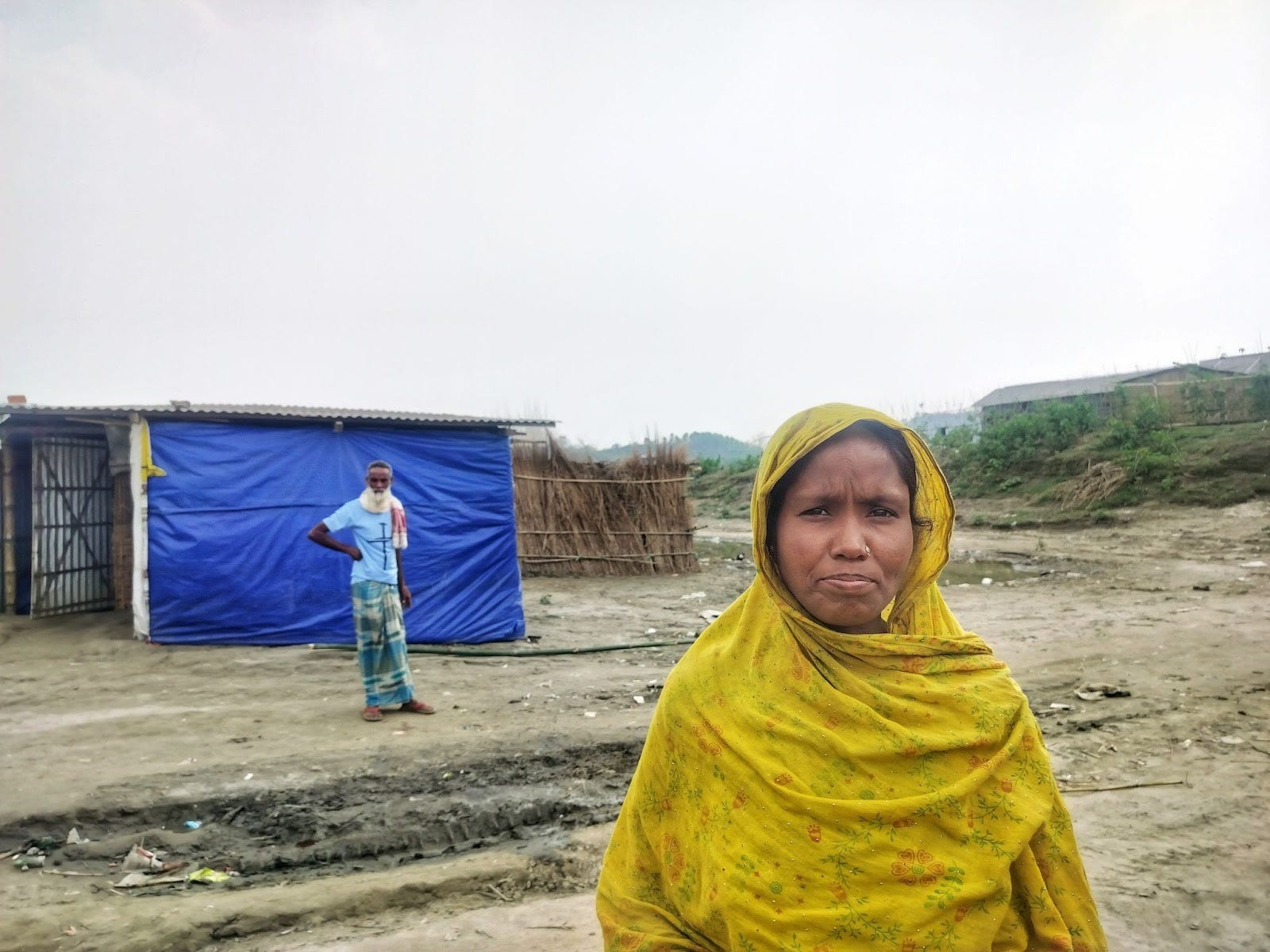
When I reached Dubapara Lupta Char, a shifting sandbar common along the Brahmaputra and its tributaries in Assam’s riverine areas, I wasn’t surprised by the conditions people were living in.
Makeshift, rickety homes built with broken tin, hay and tarpaulin sheets stood precariously, as if barely holding themselves together. After nearly seven years of working as an independent journalist in Assam, I have reported on the state’s citizenship crisis multiple times; this was a familiar sight.
This is what life on a char looks like.
Here, existence is without proper housing, electricity or toilets, and life is particularly difficult and unpredictable. As monsoons hit, growing more erratic each year, the river rises, reaching the sandbars and swallowing homes whole.
These sandbars are never permanent. Even for those who have lived and grown up by the river, cultivating its land, there is no guarantee of staying. Most char dwellers are always looking for land where they can build something more stable.
Land itself is precarious in Assam. The state loses an estimated 8,000 hectares every year to riverbank erosion. Since 1950, over 4.27 lakh hectares, about 7.4% of Assam’s total area, have been swallowed by the Brahmaputra and its tributaries. Nearly 40% of the state is flood-prone, according to government data.
For those who live along the river, displacement is not an event but a recurring condition.
I met Abul Kalam, Abu Chufiyan, Asiya Khatun, Asma Khatun, and several others on the char. They told me they were born in these riverine areas, their forefathers from here. When the river swallowed their homes, they moved to Dahikata Reserve Forest, about a kilometre away, in search of stability. Around 20-25 years ago, they bought land there, unaware then that it was forest land.
“We just knew that place as debosthan—land of god. Nobody told us anything,” Abul Kalam said. “We had been living there until the government demolished our houses last year.”
According to a 24 March 2026 report by The New Humanitarian, published in Article 14, over 20,387 families, more than 100,000 people, have been evicted across Assam due to eviction drives between May 2021 and 2026. These eviction drives have disproportionately affected the Bengali-speaking Muslim community.
Abul Kalam is 39 and has six children. His 83-year-old father had been unwell for days. They were given barely any notice, maybe a day at most. They moved whatever they could the day before. He hired a car to bring his father out because he could barely stand. When I visited, his father was visibly very sick.
Kalam used to work as a daily wage labourer, but he himself fell ill soon after the eviction. He was diagnosed with multiple conditions—pancreatitis, kidney stones, an infection in his lungs, and appendicitis. He underwent surgery that cost around Rs 3 lakh, money he pieced together with help from others. Unable to return to work, he now relies on his elder brother, also a daily wage labourer, for food and basic needs.
Kalam still has his voting rights, and he is certain he will vote. But he is unsure who to vote for. “Everyone comes asking for votes,” he said. “But nobody has done anything for us. We will vote for anyone who gives us a home.”
Evictions in Assam are tied to a longer history of migration and citizenship politics. Refugee influxes into the state after 1947, during Independence, and again in 1971, during the Bangladesh Liberation War, shaped anxieties around “foreigners.”
These tensions culminated in the Assam Accord, which set 24 March 1971 as the cut-off date for citizenship. In 2019, the updated National Register of Citizens excluded around 1.9 million people, leaving their citizenship status uncertain.
Shrinking land and recurring floods have deepened insecurities among Assam’s khilonjiya, or indigenous communities, around protecting land, identity, language and culture.
The BJP, led in the state by chief minister Himanta Biswa Sarma, has tapped into these anxieties, sharpening a narrative that Assamese identity is under threat and that Bengali-origin Muslims are “encroachers” and “outsiders”, and jaati, maati, bheti (ethnic identity, land and base) must be protected “at any cost”.
Critics often argue that eviction drives are a way to appease dominant social groups. The issue has become a central election plank.
In campaign speeches, Sarma has said that if re-elected, his government will clear five lakh bighas of land of alleged encroachment, citing the 1.5 lakh bighas cleared in the past five years during his tenure.
But, on the char, people like Kalam just want one thing: a home. As water levels rise, they know these fragile structures will not last. A few days before I visited, a storm had already torn through many of their tin and tarpaulin roofs.
“We slept in fear. It’s hard to explain how we are living here,” Abu Chufiyan, another resident of the char, who stood next to Kalam, told me. “Even a dog wouldn’t pass through this area at night, but we are living here.”
Chufiyan said he would hold the chief minister’s feet if he could. “He is still our guardian,” he said. “It’s fine if he evicted us, but at least give us a proper place to camp. Otherwise, where will our families and children go?”
Kalam told me he had little faith that telling their stories would change anything. Many people come here, he said, take photos, ask questions, write about us. “But we don’t even get to see where it is published. They come, meet us and leave. We never hear from them again.”
A few days after my visit, I called Kalam to ask how he was doing, whether the water had risen. He told me it was inching closer to their homes; they might not be able to stay even another week.
I asked about his father.
“He died two days after you visited,” he said.
Kalam’s father could not bear the trauma of the eviction and what it had done to his family, Kalam told me. Already unwell, caught between a failing body and an uncertain river, he gave up.
Read Sanskrita Bharadwaj’s full story here.
Also Read: