
Field Notes: Resisting Repression
Nikita Jain

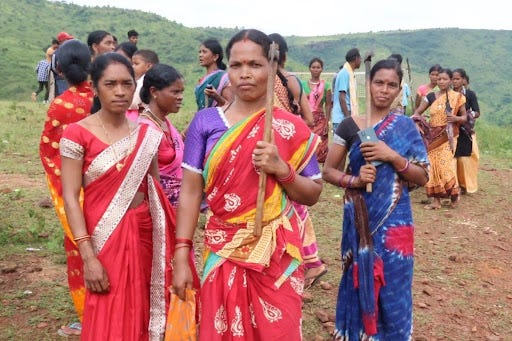
For the people of Tijimali, Kantamal and neighbouring villages, the fight for survival has only intensified.
When I travelled to Tijimali, the atmosphere was tense, charged not only with fear, but with defiance. My visit to Tijimali came with the urge to document the various indigenous communities’ dissent movements taking place in different parts of India.
But what Tijimali revealed was something larger: the familiar pattern of state-backed displacement, the harassment that follows resistance, and the criminalisation of those who refuse to give up their land.
Since 2023, tribal and Dalit communities in the region have been protesting against a proposed bauxite mining project by Vedanta Ltd., the Andhra Pradesh-based mining giant. The project was approved under the Biju Janata Dal government led by Naveen Patnaik. But after the Bharatiya Janata Party came to power in Odisha in 2024, villagers say the pressure to operationalise mining has sharply increased.
Sipping chai while overlooking Tijimali’s lush green hills, local activists told me their movement draws inspiration from the historic Niyamgiri movement. In the landmark struggle, the Dongria Kondh tribe successfully resisted Vedanta’s attempt to mine the Niyamgiri Hills, barely 74 kilometres away.
In 2013, the Supreme Court ruled in favour of the local communities, affirming their rights to the community’s forest and religious rights.
“Niyamgiri gave us hope,” said Subhu Singh Majhi, president of Maa Mati Mali Surakhya Manch, a grassroots organisation formed by local residents, as we sat at the Tijimali hilltop protest site where Vedanta plans to begin excavation. “If our brothers and sisters there could win, so can we. Our ancestors protected this land, the rivers and the forests. Now we are the ones being pushed out.”
The cost of that resistance was visible in every conversation.
When I met Kumeshwar Naik of Kantamal village, he had only recently returned from prison. He had completed what many here describe as a deeply humiliating bail condition imposed by the Odisha High Court: cleaning the local Kashipur police station.
Naik had missed the birth of his child while in custody.
“At first, I was only surprised,” he told me. “Later, I realised what it meant. Because we are tribals and Dalits, they think such punishment is acceptable. We were arrested for protesting for our rights.”
His was not an isolated case. Accessing court records and speaking to villagers revealed a disturbing pattern of how identical caste-coded punishments, repeated arrests, and legal processes were used.
Even now, as the protest continues, so do the arrests.
On 11 March 2026, more than 21 tribal villagers, including 12 women, were detained during demonstrations against Vedanta; nine have only recently secured bail. This followed a violent clash when police attempted to forcibly displace families for a three-kilometre road meant to connect Porolang to Sagabari Ghati, easing access to the proposed mining site.
An FIR now names a doctor as the alleged mastermind, alongside 100 unnamed persons.
In Tijimali, that can only mean one thing: the cycle of arrests, humiliation and repression is far from over.
Read Nikita Jain’s full story here.
Also Read: