
Field Notes: Mohammed Harun & Madhya Pradesh’s Unfolding Apartheid
KASHIF KAKVI

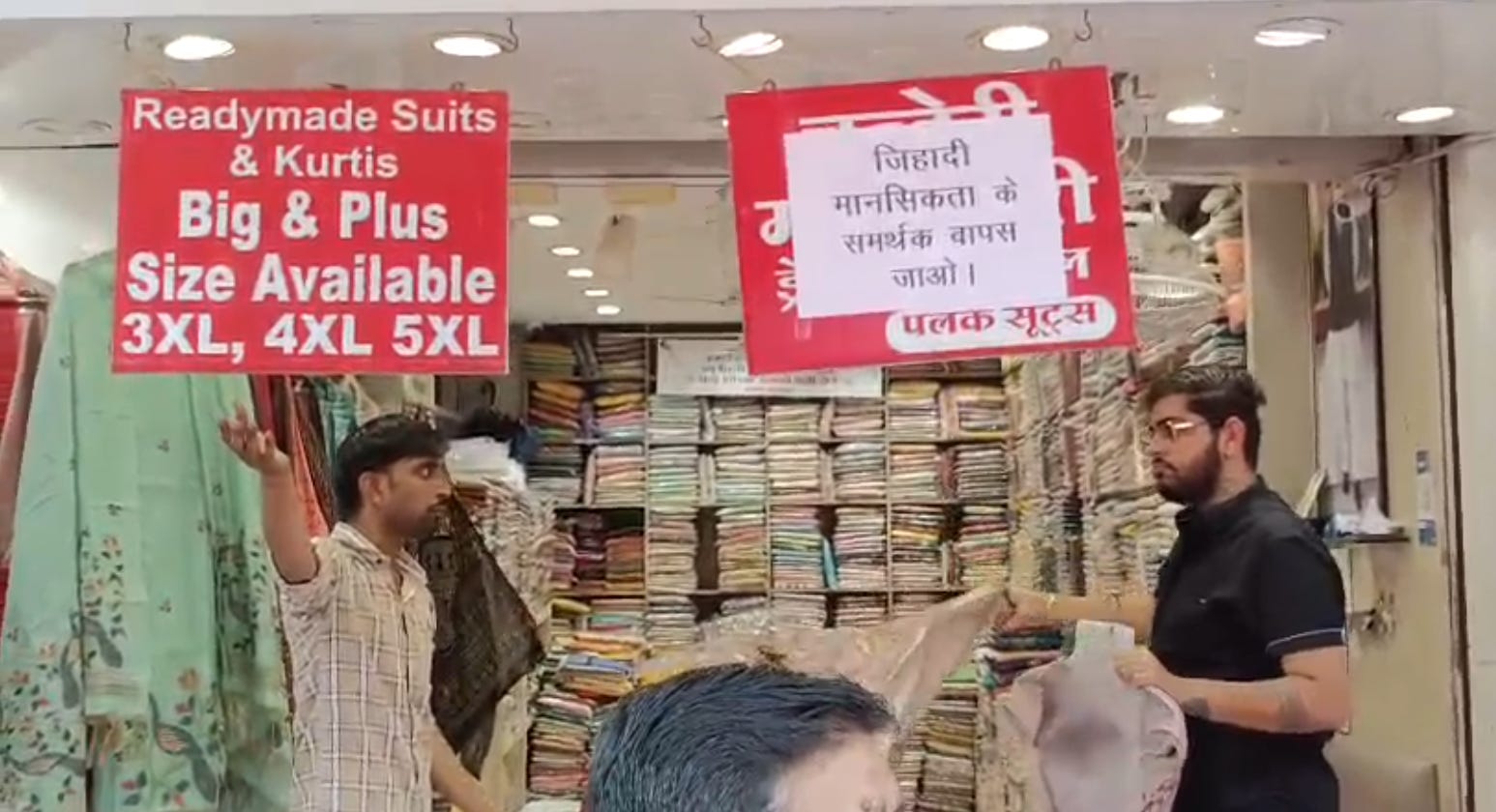
Mohammad Harun, 55, stood on the road a km away from a place he had made his livelihood for about four decades, Indore’s oldest garment market, quietly discussing how his efforts to lead a life without controversy or trouble had come to naught.
“We were well equipped to handle any kind of adversity a garment merchant could face,” said Harun, a confident and soft-spoken garment trader, who built a business from scratch over 40 years, as did many other Muslims in the market.
“Humne apni taraf se koi kasar nahi chodi thi. Humara record bedag tha. Hum waqt per rent dete the, sab se miljul kar rahte the (We had made every effort. Our records were clean. We always paid rent on time, and lived together with everyone),” said Harun. “But we never imagined our faith would be weaponised against us,”
On 25 September 2025, Harun was evicted by his landlord—his only fault, his religion. Every Hindu in the market was pressured by Hindu extremists to cut ties with Muslims, who they alleged—with no evidence—were involved in luring Hindu women to friendship, marriage and conversion to Islam.
“There is no place left to seek justice,” said Harun. The police and district administration, he alleged, deliberately overlooked the traders’ complaints against Hindu vigilantes who coerced landlords to evict Muslim tenants.
The open call for political and economic isolation of Muslims in India is not new. Over the last decade, states run by India’s ruling Bharatiya Janata Party (BJP), such as Uttarakhand, Maharashtra, Uttar Pradesh, Gujarat, Haryana, Madhya Pradesh and—the latest—the National Capital Territory of Delhi, have given free rein to Hindu stormtroopers. Islamophobia and violence against Muslims, amplified under State patronage, have divided society more sharply along religious lines—a division clearly visible in Madhya Pradesh, especially in Malwa and Indore.
My experience living and reporting here shows that ghettoization is deepening in rural areas, with explicit exclusion now routine. The propaganda term and conspiracy theory of “love jihad,” has moved from a whisper on the Hindu far right to a loud fact, used and weaponised by the ruling party, its legislators and their supporters. With no proof that it even exists, love jihad–the allegation that young Muslim men lure or coerce young Hindu women into marriage and convert them to Islam—is a widely used tool to manipulate public sentiment and isolate Muslims.
Economic boycotts evolved from slogan to policy, as I chronicled in my recent story from Indore. That call for boycott was not shocking to me, as a journalist who had covered Central India for years and witnessed countless State-supported incidents of Islamophobia and violence over the decade.
In 2022, Article 14 reported how, after a riot that broke out in the town of Khargone in April, on Ram Navami, boycotting Muslims became a household slogan. Shops and homes rented by Muslims were vacated in the months that followed. The Indore police’s record of impunity in cases involving hate-mongering BJP leaders is now an established fact—from the COVID-era targeting of Muslims, to the arrest of comedian Munawar Faruqui over a fake complaint, and the attack on UP bangle seller Tasleem Ali.
But then, at least, the police and district administration made some effort to respond. This time, all neutrality collapsed. Institutions were compromised. Not even political pressure could command a response, nor was there any pretence that the police were unbiased.
What shifted this time was the silent assent of government and law enforcement—victims’ appeals and interventions by opposition figures, including former Congress chief minister Digvijay Singh and state Congress President Jitendra Patwari, were ignored. Even the Madhya Pradesh High Court—long known for suo motu action on social issues—stayed silent.
Congress spokesperson Ameen Ul Khan Suri called out the government’s double-standard, pointing to chief minister Mohan Yadav’s visit to Dubai in July. “For three days,” said Suri, “He met and wooed Muslim business tycoons, pitching safety and inclusivity, and earned investment proposals worth over Rs 1,000 crore. But just 30 days later, in Indore—the economic capital—150 Muslim men were thrown out of the market for their identity.”
Fearful Muslim salesmen and traders, evicted and struggling to survive, initially refused to meet me in the garments market. It was only after Singh publicly extended support that they agreed to speak. Hours later, they agreed to gather after dusk at a quieter street corner in the Jama Masjid locality, where I met Harun.
Aged between 22 and 55, they recounted evictions and harassment but declined to be photographed or filmed. Several said they had loans, rent, and school fees to pay.
“Will this report change anything?” one asked me. “Can we get back our shops?” asked one. All I could offer was truthful reportage of their situation and urged them not to lose hope.
I must admit, in a state where a great silence has fallen over crimes against Muslims and the growing apartheid against them, that is a faint hope.
You can read Kashif Kakvi’s full story here.
Also read:
this is heart breaking.
I got the same Munawar Faruqui's show cancelled in Chhattisgarh, that too under a Congress government.
I hope you don't spread such lies the next time you are in Chhattisgarh, Mr. Kakvi (kakvi544235@gmail.com)