
Field Notes: Haryana, Where Have All The Trees Gone?
ROMITA SALUJA

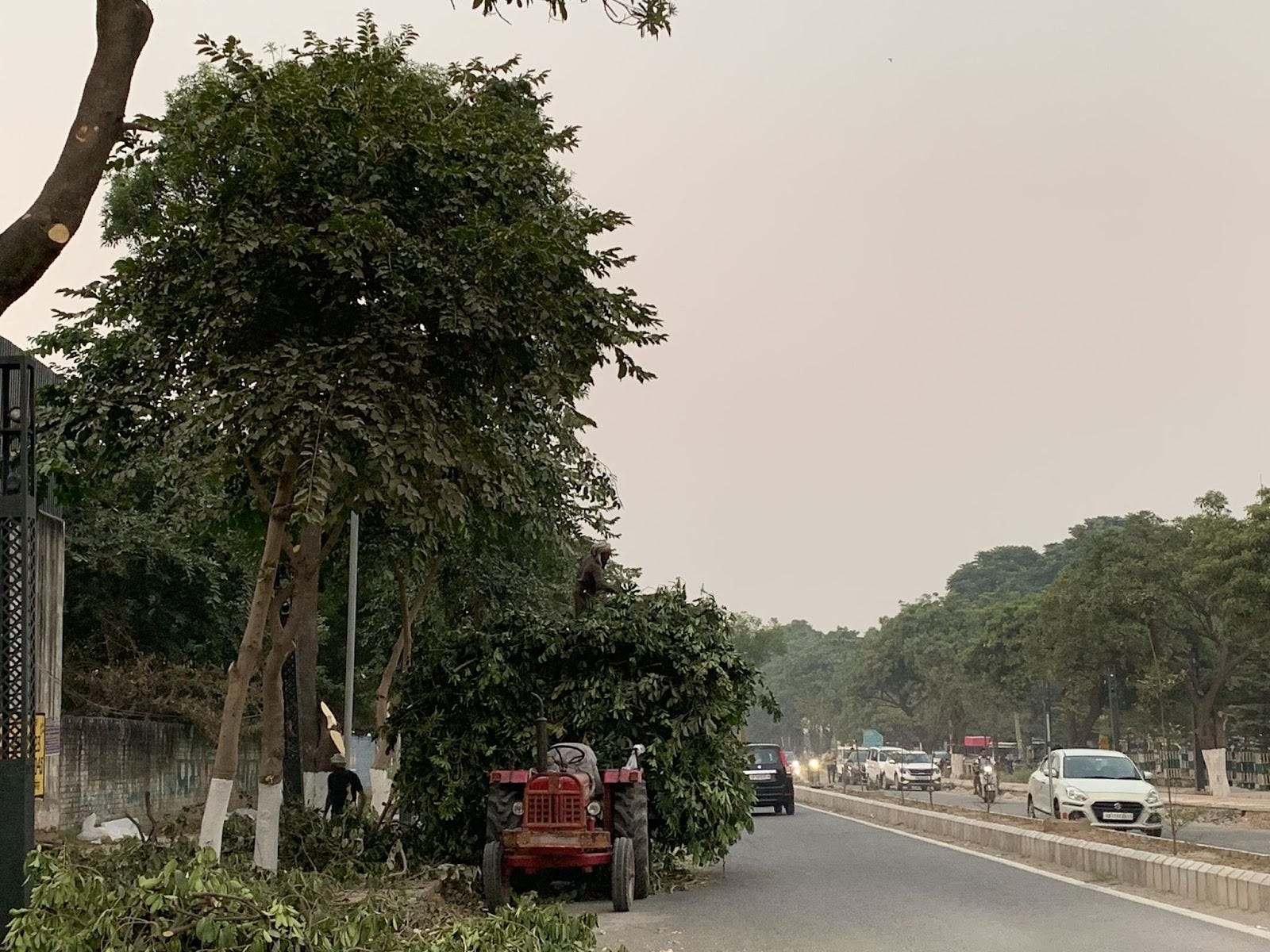
One day, three years ago, I woke up to find 11 trees missing in front of my house.
The neighbours who had witnessed the incident—and didn’t resist—told me later that the branches were colliding with aerial electric wires. So the people managing the gated community in Haryana brought a chainsaw and reduced the fully grown, lush, healthy trees to 5-foot-tall stumps. Their decaying wood still stands there, a brutal reminder of the State and the people's callous attitude toward trees and the natural environment.
Months later, in a déjà vu moment, one late morning, I rushed to another gated community where workers had felled at least two dozen trees and were ordered to uproot at least a dozen more. I demanded to know if they had sought permission to cut the trees. Their supervisor replied: “The trees stand on our land. We can do whatever we want.”
I frantically looked through my contacts to find activists, NGOs, government officials—anyone who could stop the further cutting. A local activist who had protested the felling of trees for a highway project a few years earlier said he couldn’t get involved in this case but shared the contact details of an official at Haryana’s environment ministry. The official asked me to write an email to his department. I wrote three and a half a dozen text messages in between numerous follow-up phone calls. No action was taken.
All the remaining trees were brought down over the next few days.
These were among the first instances of tree-cutting I documented in Haryana. In the last three years, as I reported in my story, I have witnessed the cutting of at least 150 trees and heard about the killing of dozens more from my sources around Haryana.
Some of the reasons people cited while cutting down the trees were: trees drop leaves on their cars, snakes live in trees, and trees block the sunlight. One person said cutting trees is as natural as trimming your hair. One got so aggressive when I mentioned the rising cases of asthma among children due to the notoriously polluted north Indian air that I had to call someone for help.
As someone who, for most of her life, has lived in or around the national capital, where people are protesting for clean air and struggling to find green, walkable spaces, while others pack up their bags in search of breathable cities, I was baffled.
Can you simply wipe out a dozen trees without facing any action? Is any authority doing anything about the pollution here? And whose trees are they, anyway?
An official at the state pollution control board said, in 2024, that acting on tree-cutting wasn’t the department’s responsibility. A few forest department officials in different cities of Haryana said something similar.
Senior environmentalists and activists directed me to the Punjab Land Preservation Act, 1900, a British-era law still used in Haryana to protect urban trees. But environmental lawyers confirmed that it only applies to 10 of its 22 districts.
“So there’s practically no law at all to save these trees?” I asked one of them.
“No,” he replied.
A local journalist I reached out to said he couldn’t cover the issue in detail because his editors didn’t support stories like this.
A divisional forest officer finally assured me of an investigation after the story’s publication. But so far, no action has been taken.
Meanwhile, people continue to cut trees. And I continue to document the incidents. In the most recent incident, a resident had at least three trees cut, saying he wanted a streetlight installed. A few days later, armed with a measuring tape, I went to check the distance between the denuded trees and the street light: 25 feet.
Read Romita Saluja’s full story here.
Also read: